sūveryn › M&A lawyers
Your data. Your premises. Your AI.
A deal leaks once, and the price, the timetable or the deal itself can be gone. Sūveryn gives your M&A team AI for due diligence, contract review and drafting that runs on servers you own. The data room, the drafts and the questions your team asks never leave your perimeter.

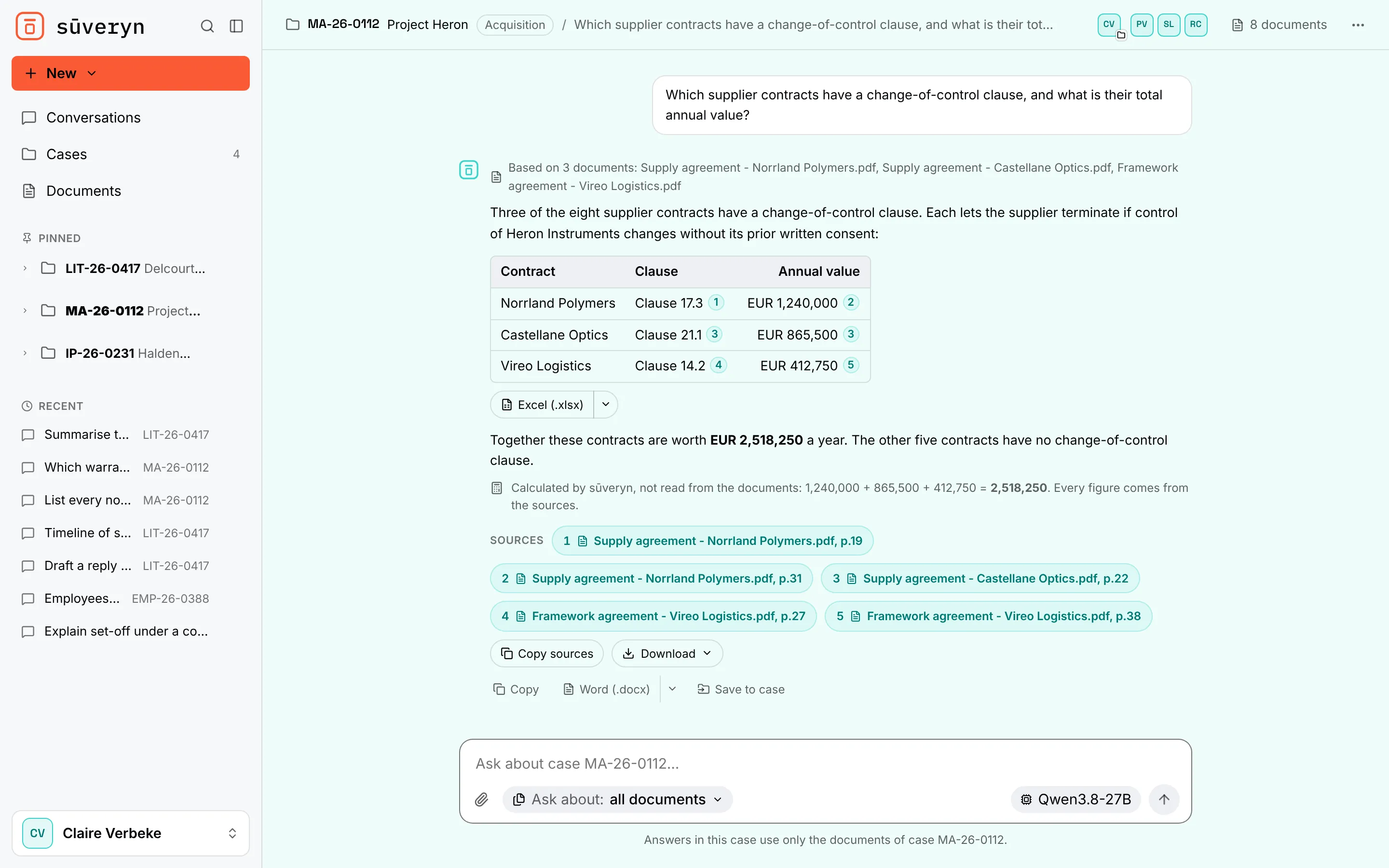
Ask the questions a due diligence turns on, such as change of control, exclusivity, termination and liability caps, across up to 50 contracts at a time. Sūveryn answers from the documents on your own hardware and links every finding to the page it came from. Totals are calculated by the server, not guessed by the model, and any figure that isn’t in the documents is flagged. Nothing is uploaded to a cloud provider or a model vendor.
On a listed target, what your team knows before announcement is inside information. Firms acting for an issuer may have to keep an insider list of everyone with access, with the exact date and time. Sending the same documents to an outside AI service adds a party you have to account for. With sūveryn there is no such party: the AI runs within the firm, under your own access controls.
Many “legal AI” products are wrappers: a branded interface that sends your prompts and files to another company’s model, often in another jurisdiction. Their answer to confidentiality is a contract: an EU region, a no-training clause, a retention limit. As the CCBE puts it, “the less we control the stack, the more we must ensure the control by contractual obligations to the provider and rely on promises from a vendor.” Sūveryn takes the other route. Nothing leaves your premises, so there is nothing to negotiate, and you can prove it: switch it to air-gapped mode and it keeps working.
| A typical AI wrapper | Sūveryn | |
|---|---|---|
| Where the model runs | On the model provider’s servers | On your server, on your premises |
| Who receives your documents | The tool vendor and the model provider | No one outside the firm |
| What protects your data | Contract clauses: region, retention, no training | Architecture: nothing leaves, even air-gapped |
| Can you check what it does | Closed code | Open-source code and published limitations |
| Works without an internet connection | No | Yes |
| If the vendor changes terms or stops | The service changes or stops | Code (AGPL) and models (Apache 2.0) stay with you |
| Answers checked against the sources | Depends on the product | Each citation checked against its passage; sums calculated by the server |
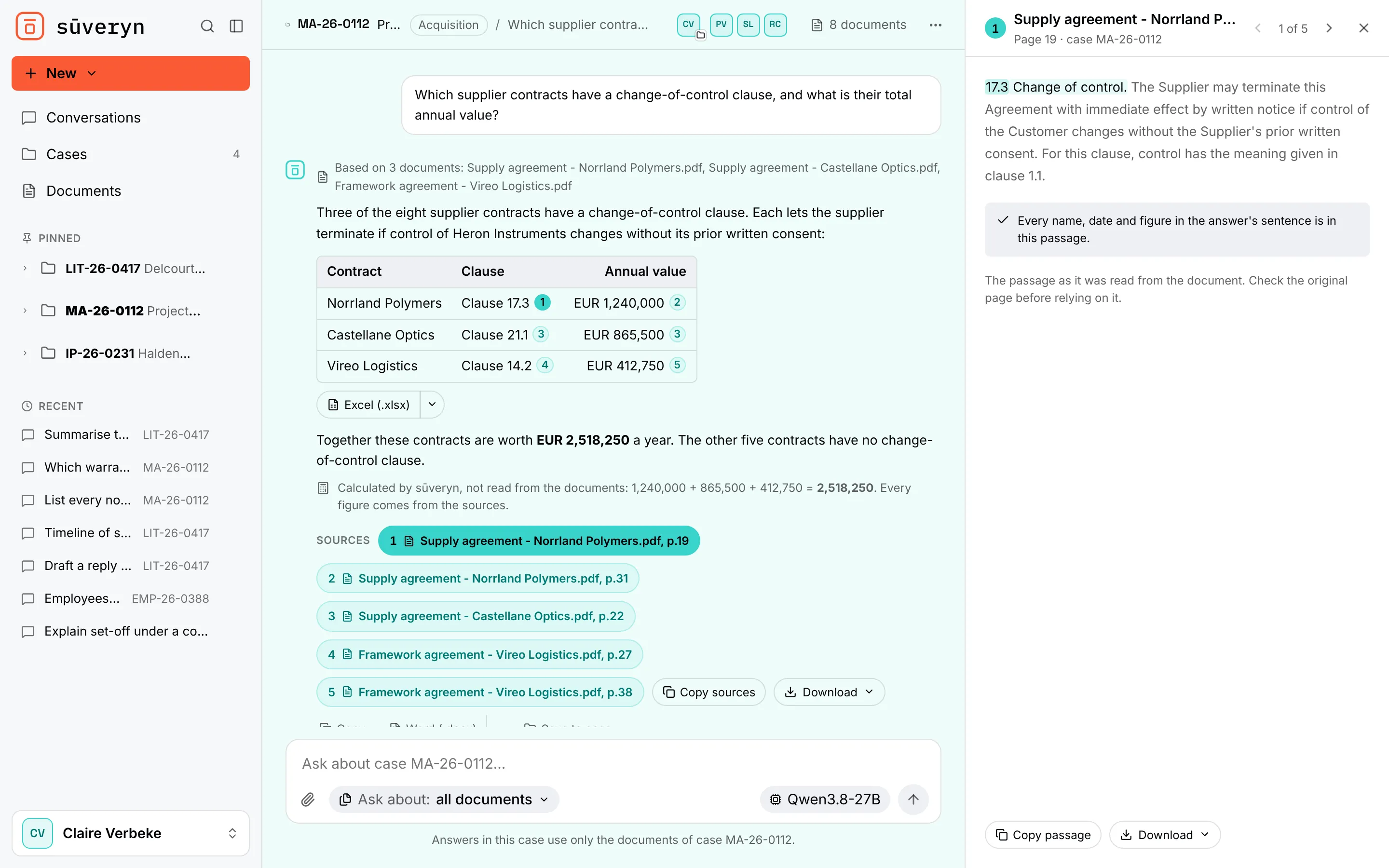
A lawyer can’t use an answer they can’t trace. Every sūveryn answer cites the passages it rests on, with the page, and opens each one with the sentence marked. Each citation is checked against its own passage: a figure, date or name that isn’t there is flagged. Sums are calculated by the server, not by the model. The bars expect lawyers to verify AI output before relying on it; a page citation turns that from an afternoon’s work into a minute’s. And text inside a document is never treated as an instruction, so a planted line in a document from the other side can’t steer the answer.

Europe’s bars point the same way. The CCBE’s technical guide on the use of AI tools and models by lawyers (27 March 2026) calls on-premise deployment “the most secure option regarding the respect for confidentiality”: the data “remains within the control of the lawyer. There is no transfer of data to a third person.” With a cloud service, it warns, “the data leaves user’s environment which, in case of lawyers, can raise confidentiality issues.” The professional duties behind this are in its guide on the use of generative AI by lawyers (2 October 2025). With sūveryn, confidential data stays confined to the firm: on your own premises, under your own access controls, with no outside provider that receives or keeps it.
Whether your teams advise buyers, sellers, sponsors or lenders, the rule is the same: the fewer outside parties see the deal, the better. Every outside service that touches a deal is one more party to vet, contract with and answer for. Sūveryn adds none: the AI sits on your own server, under your own rules. Your deal teams get AI support, and you keep a simple answer for clients who ask where their information goes.
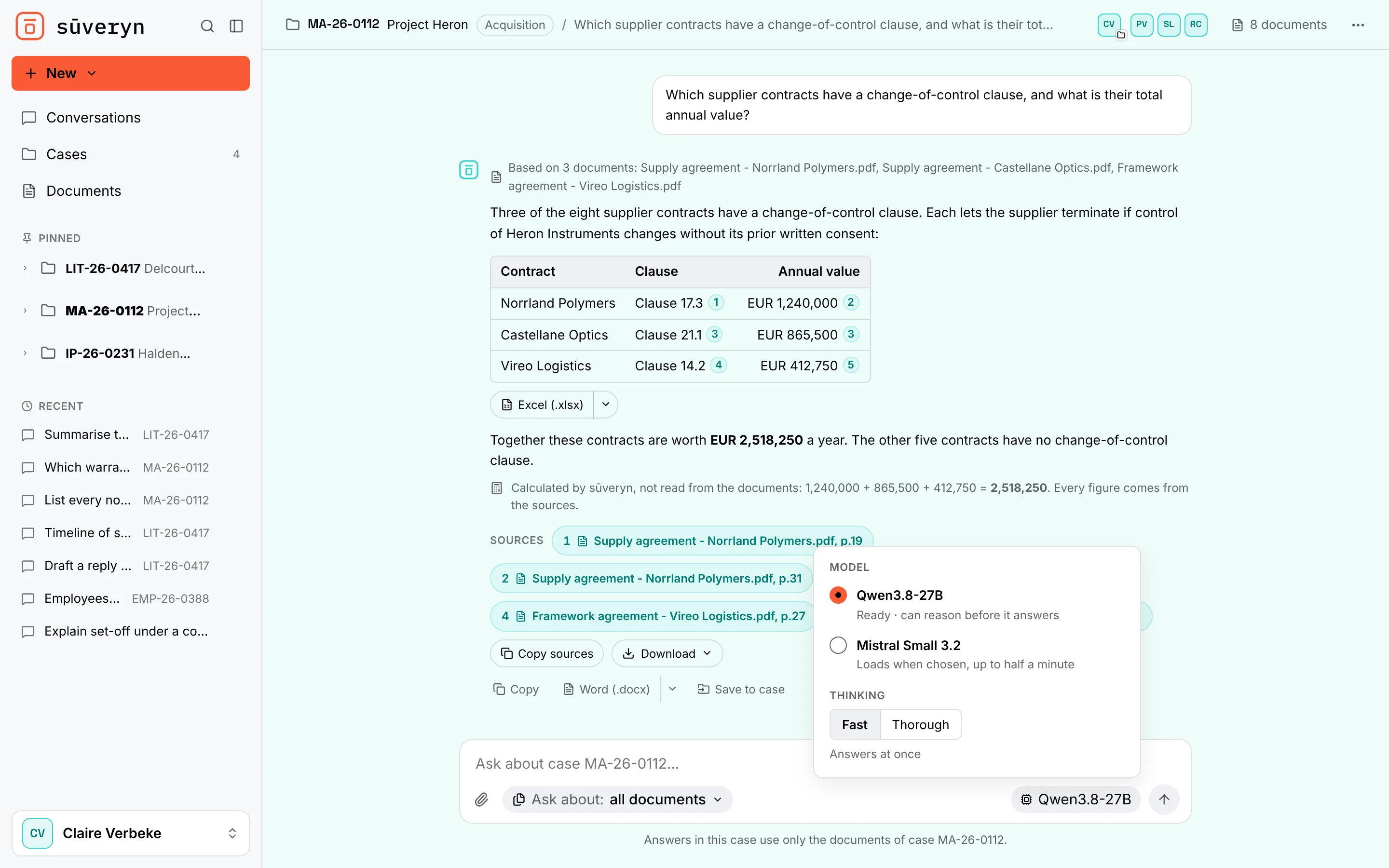
Sūveryn ships with two open-weight models, Qwen3.8-27B and Mistral Small 3.2, and your people choose the model per conversation. No model vendor sees your work. It runs on one server with a 24 GB NVIDIA GPU (RTX 4090 class).

Hosting it with your IT provider instead of in your own office needs a data-centre GPU; contact us before planning that.
The code behind sūveryn is open source, so anyone can inspect it: your IT team, an outside security firm, a sceptical partner. That is the point. A tool that holds privileged files shouldn’t ask for blind trust. The code is public; your data never is. Read the Sūveryn Manifesto for why we build this way.
Many NDAs limit who may see the information. Because sūveryn runs inside the firm, no outside AI provider receives it. Check each NDA’s own terms.
A wrapper is a tool built on another company’s AI model through its API. Your documents go to the tool vendor and on to the model provider. Sūveryn has no such chain.
The AI runs on your own systems, so it adds no outside party with access. Who on your team has access still needs to be recorded as usual.
It ships with two open-weight models, Qwen3.8-27B and Mistral Small 3.2, running on your own hardware.
Sūveryn is in development. Join the waitlist to run a pilot on a closed deal file.
Join the waitlist to run a pilot on a closed matter, on a server in your own office, and judge the answers yourself.
Sūveryn for other practices