sūveryn › IP lawyers and patent attorneys
Your data. Your premises. Your AI.
Before filing, an invention is only as safe as the last place it was sent. Sūveryn gives your IP team AI for invention disclosures, prior art and office actions that runs on a server you own. Unfiled inventions, trade secrets and litigation strategy never leave the firm.

Novelty is judged on what was made available to the public before the filing date. Sending an invention disclosure to a cloud AI service doesn’t make it public, but it does put it on someone else’s servers, under their terms on retention and training. That is a risk no client should have to weigh. With sūveryn, the disclosure, the drafts and every question about them stay on your own premises.
Under the EU Trade Secrets Directive, information is only protected as a trade secret if its holder took reasonable steps to keep it secret. Handing it to an outside AI service is hard to square with that. Keeping the AI on your own server is the simplest reasonable step there is.
Many “legal AI” products are wrappers: a branded interface that sends your prompts and files to another company’s model, often in another jurisdiction. Their answer to confidentiality is a contract: an EU region, a no-training clause, a retention limit. As the CCBE puts it, “the less we control the stack, the more we must ensure the control by contractual obligations to the provider and rely on promises from a vendor.” Sūveryn takes the other route. Nothing leaves your premises, so there is nothing to negotiate, and you can prove it: switch it to air-gapped mode and it keeps working.
| A typical AI wrapper | Sūveryn | |
|---|---|---|
| Where the model runs | On the model provider’s servers | On your server, on your premises |
| Who receives your documents | The tool vendor and the model provider | No one outside the firm |
| What protects your data | Contract clauses: region, retention, no training | Architecture: nothing leaves, even air-gapped |
| Can you check what it does | Closed code | Open-source code and published limitations |
| Works without an internet connection | No | Yes |
| If the vendor changes terms or stops | The service changes or stops | Code (AGPL) and models (Apache 2.0) stay with you |
| Answers checked against the sources | Depends on the product | Each citation checked against its passage; sums calculated by the server |
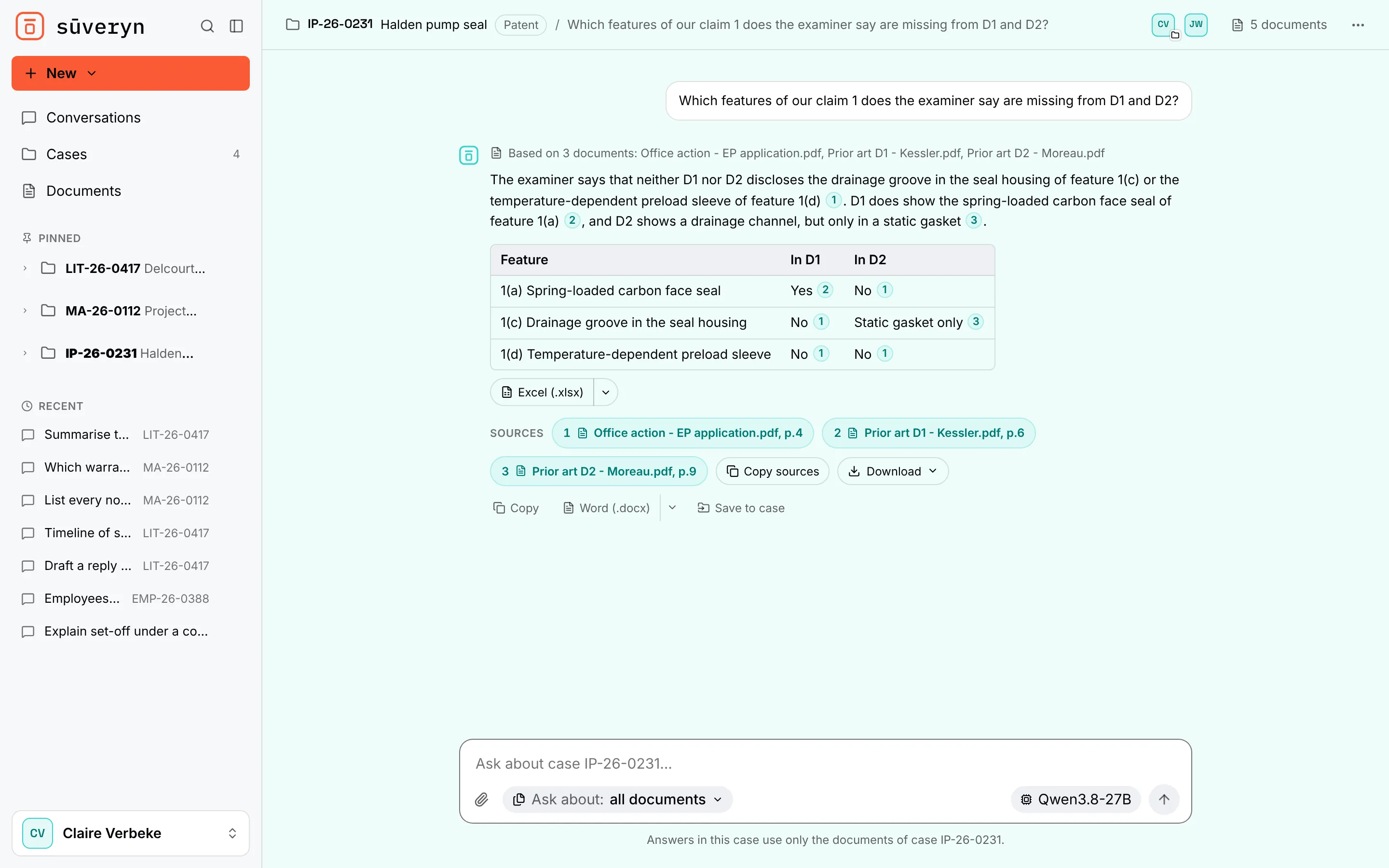
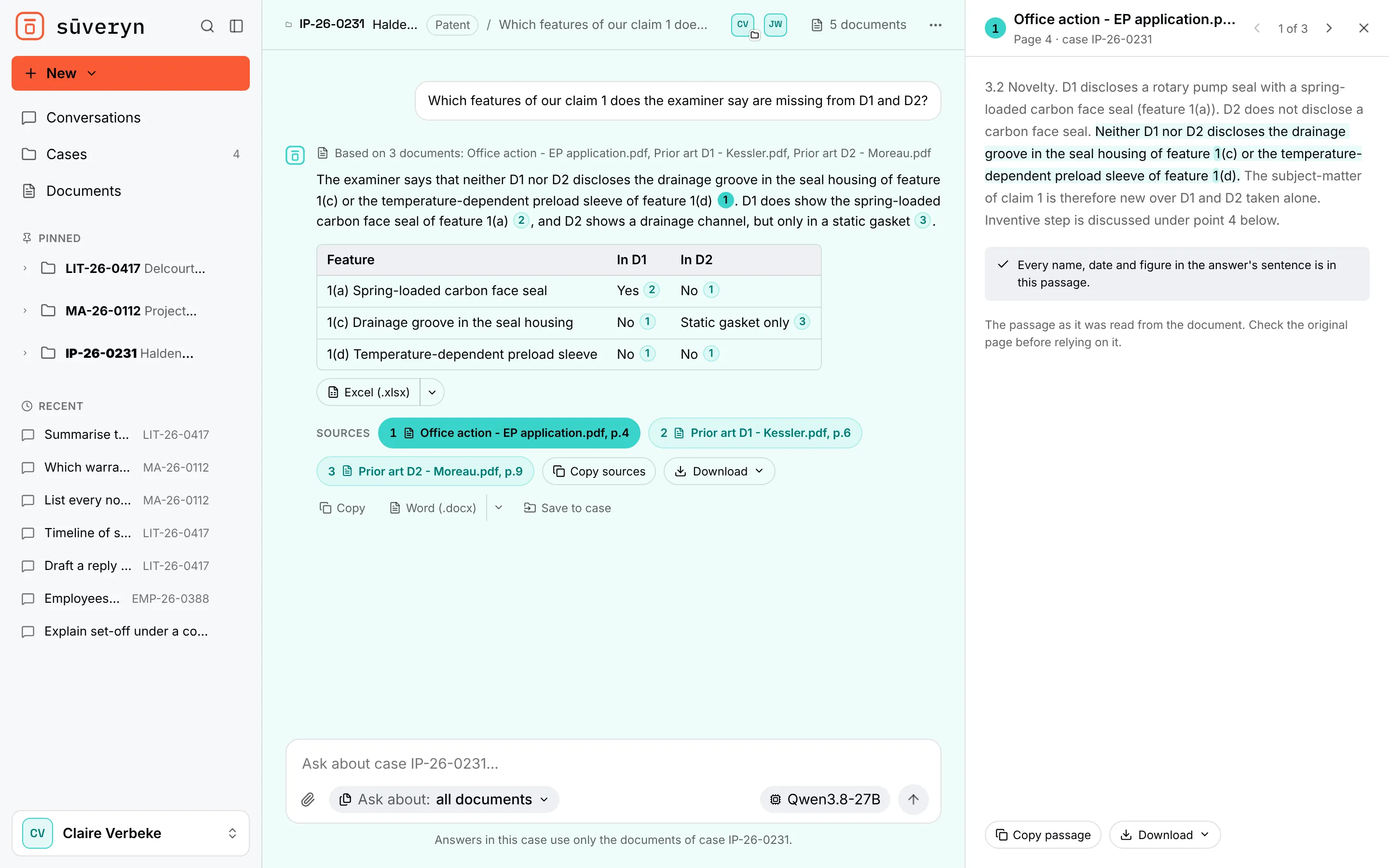
A lawyer can’t use an answer they can’t trace. Every sūveryn answer cites the passages it rests on, with the page, and opens each one with the sentence marked. Each citation is checked against its own passage: a figure, date or name that isn’t there is flagged. Sums are calculated by the server, not by the model. The bars expect lawyers to verify AI output before relying on it; a page citation turns that from an afternoon’s work into a minute’s. And text inside a document is never treated as an instruction, so a planted line in a document from the other side can’t steer the answer.

Europe’s bars point the same way. The CCBE’s technical guide on the use of AI tools and models by lawyers (27 March 2026) calls on-premise deployment “the most secure option regarding the respect for confidentiality”: the data “remains within the control of the lawyer. There is no transfer of data to a third person.” With a cloud service, it warns, “the data leaves user’s environment which, in case of lawyers, can raise confidentiality issues.” The professional duties behind this are in its guide on the use of generative AI by lawyers (2 October 2025). With sūveryn, confidential data stays confined to the firm: on your own premises, under your own access controls, with no outside provider that receives or keeps it.
Inventors and in-house IP counsel want to know where their disclosure goes before it is filed. With sūveryn the answer is short: it stays on our own server and nowhere else. That is a reason to choose your firm, not a footnote in the engagement letter. Start with a pilot on a closed file.
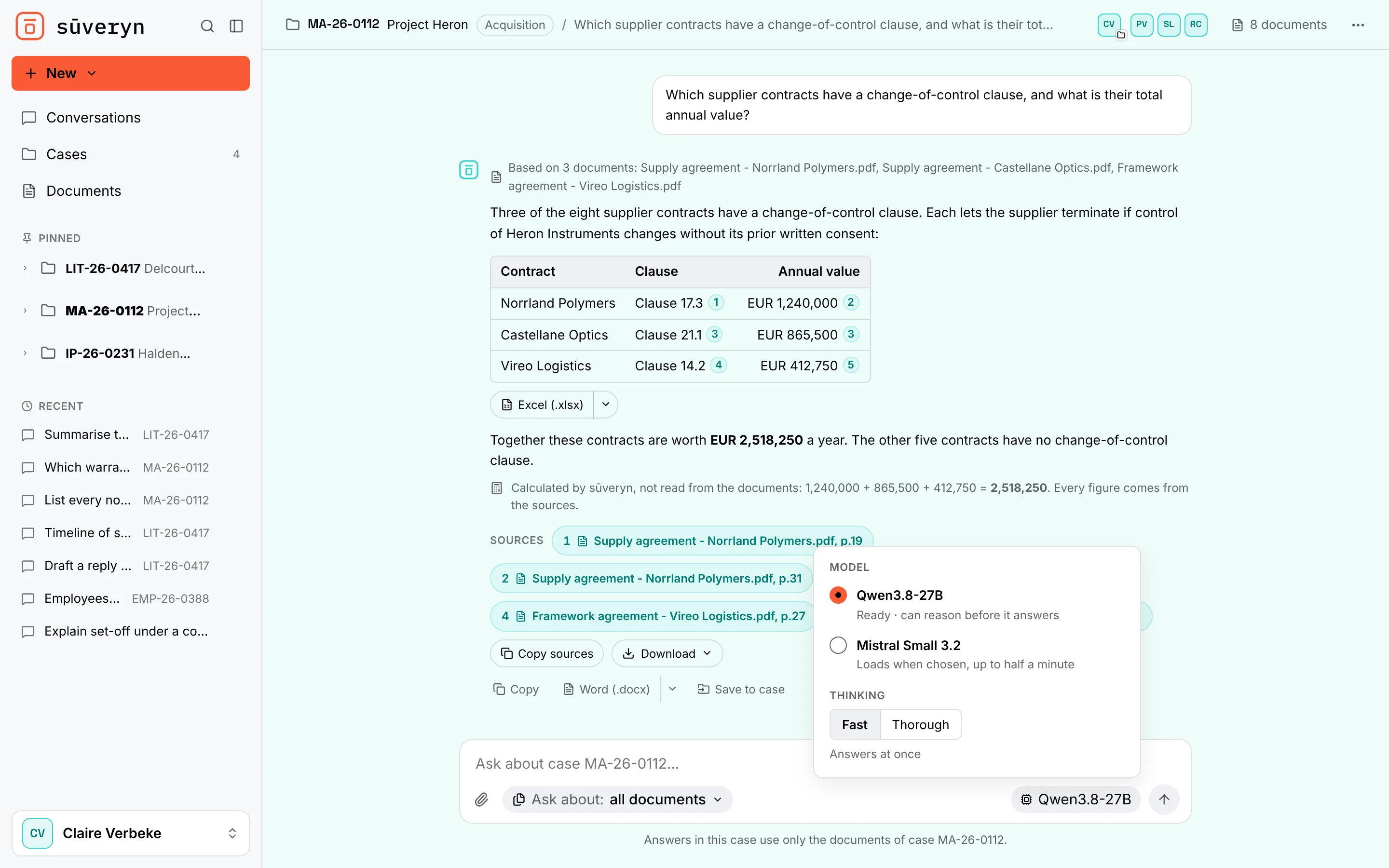
Sūveryn ships with two open-weight models, Qwen3.8-27B and Mistral Small 3.2, and your people choose the model per conversation. No model vendor sees your work. It runs on one server with a 24 GB NVIDIA GPU (RTX 4090 class).

Hosting it with your IT provider instead of in your own office needs a data-centre GPU; contact us before planning that.
The code behind sūveryn is open source, so anyone can inspect it: your IT team, an outside security firm, a sceptical partner. That is the point. A tool that holds privileged files shouldn’t ask for blind trust. The code is public; your data never is. Read the Sūveryn Manifesto for why we build this way.
Not automatically: a confidential disclosure isn’t a public one. But it puts the invention on a third party’s servers under their terms, and you carry the burden of showing it stayed confidential. With sūveryn, there is nothing to show.
It reads the text of every page, scans included. Text inside small images, such as labels in a drawing, may be missed.
The interface works in English, Dutch and French; the models read documents in all three and in German.
Sūveryn is in development. Join the waitlist to run a pilot on a closed file.
Join the waitlist to run a pilot on a closed matter, on a server in your own office, and judge the answers yourself.
Sūveryn for other practices