sūveryn › Playbooks

Your data. Your premises. Your AI.

Playbooks: a routine for each task, with a person at every checkpoint

Much of the work in a professional office follows a routine: collect the documents, read the facts, check them, produce the summary, the checklist or the first draft. A sūveryn playbook runs that routine with you, on your own server. The model reads and proposes; your office decides.

We reply within two working days.

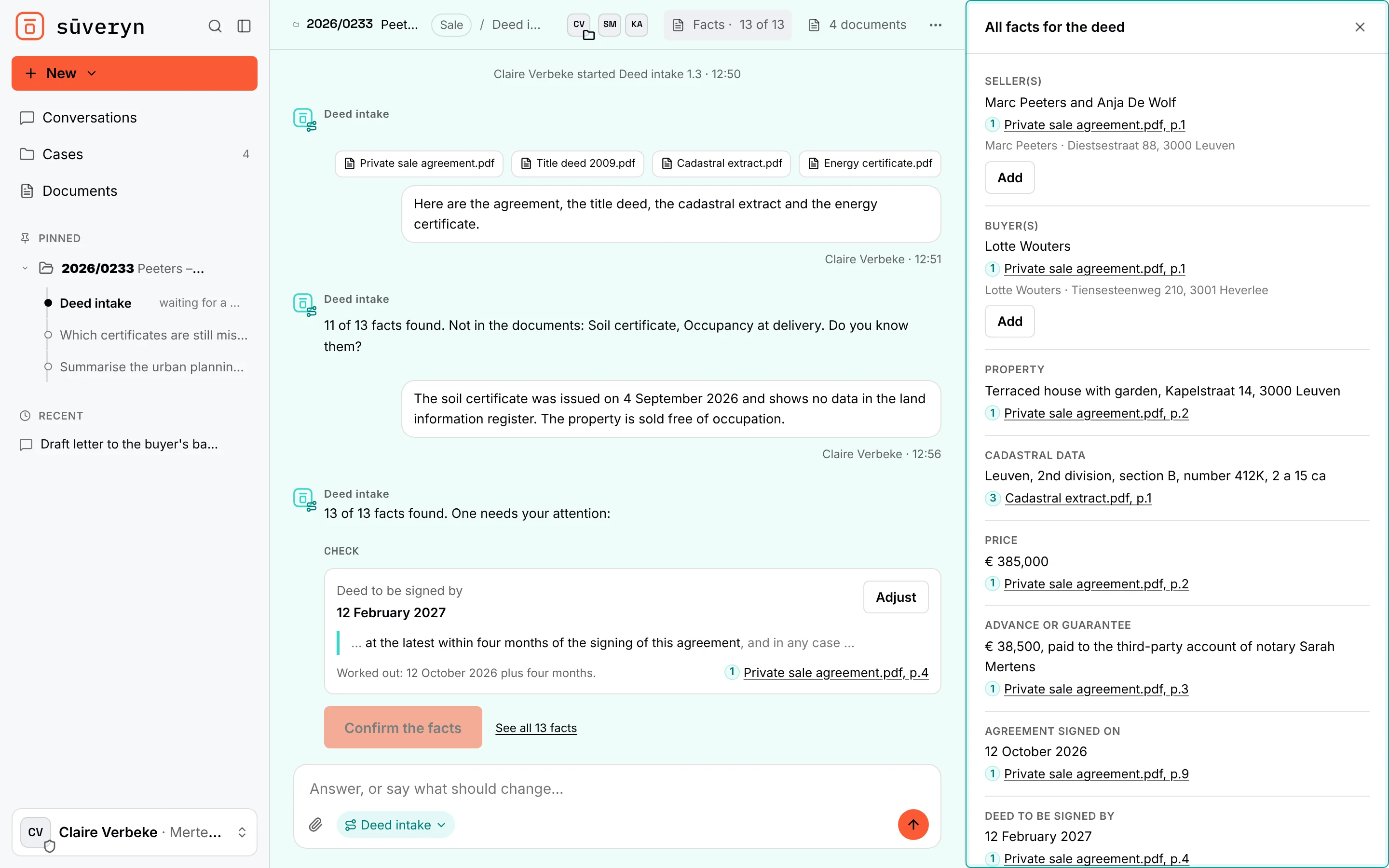
A playbook as a conversation: deed intake asked for the documents, read the facts, asked about two it could not find, and now waits at the checkpoint with the thirteen facts, each with its source, beside the thread.
Example with fictional case files · click to enlarge

A deed intake, start to finish

Under a minute, without sound: one run of the Deed intake playbook on a fictional sale file, from the documents to the summary in the case.

Example with a fictional file · no sound, captions in the film

A conversation with a routine

When a playbook is active in a case, it holds the chair. It asks for the documents the task needs, reads them, shows what it found and what it could not find, asks about the gaps, and waits for a person to confirm every fact before it moves on. At the end it produces something: a summary, a checklist, a dossier, a first draft.

Everyone who works on the case contributes through that routine, so the record shows who provided what, from which document, and who confirmed it.

The model proposes, your office decides

A playbook is not a chatbot with a script. Four rules hold whatever the playbook says:

A playbook is a file, not code

A playbook is a manifest: a short YAML file that names the facts a task needs and the steps of the routine. One runtime on the appliance interprets it. Because it is data, whoever has to approve it can read it in full, it can be versioned, signed and certified, and an office can adapt it without a developer. This is the shape, with an example for a litigation intake:

manifest: 3
id: playbook/example/claim-intake
pack: pack/example
version: "1.0"
name: Claim intake
case_types: [litigation]

facts:
  - id: parties
    ask: the parties, one entry each, as named in the writ
    kind: list
    of:
      - id: name
        ask: the party's full name as written
      - id: role
        ask: claimant or defendant
  - id: court
    ask: the court seised and the case number
  - id: service_date
    ask: the date the writ was served
    kind: date
  - id: hearing
    ask: the date of the introductory hearing
    kind: date
  - id: claim
    ask: the principal amount claimed
    kind: amount

instructions: >-
  Read the excerpts and give every fact as the documents
  write it, with the excerpts it comes from. A fact the
  excerpts do not contain is null: never guess.

steps:
  - id: writ
    kind: request        # ask for the writ and what the client sent
    min: 1
  - id: read
    kind: read           # the model reads the facts, each with its source
    facts: all
  - id: missing
    kind: ask            # one question per fact the documents did not contain
    facts: all
  - id: served_in_time
    kind: check          # the server checks: served before the hearing
    rule: service_date < hearing
  - id: confirm
    kind: checkpoint     # the case manager confirms or corrects every fact
    by: manager
  - id: summary
    kind: produce        # the confirmed facts as a document in the case
    template: summary

An example in the shipped format, not a shipped playbook.

Six kinds of step exist today: request a document, read facts from the documents, ask about what was not found, check, a checkpoint, and produce a document. Facts can be lists (one entry per seller or founder), numbers, amounts, dates or choices; a step can depend on a choice, and a check computes on the values and shows the result at the checkpoint, never as a block. A checkpoint can be reserved for the case manager: the clerk prepares, the notary confirms. Next come passages the model drafts for a person to accept or rewrite, such as a company’s object, and products from your office’s own templates. The format is public: deed intake, the first playbook, is the reference.
What ships today, and what comes next

Three playbooks run in the pack for Belgian notaries. Deed intake for a sale reads thirteen facts from the sale agreement, the title deed and the certificates, with sellers, buyers and conditions as lists. It runs five checks and gives the office a confirmed summary as a Word file.

Company formation for a BV reads the founders from their identity documents and the financial plan, each with their shares and contribution, and checks that these add up and that the bank certificate matches the money contributed; a contribution in kind asks for the reports instead. Care mandate prepares a new zorgvolmacht: the principal, the agents and who succeeds them, the powers and the conditions.

Playbooks for litigation, M&A and IP work follow where pilots show which routines matter most. Until then those practices use sūveryn as the practice pages describe: questions across a case’s documents, each answer with its source.

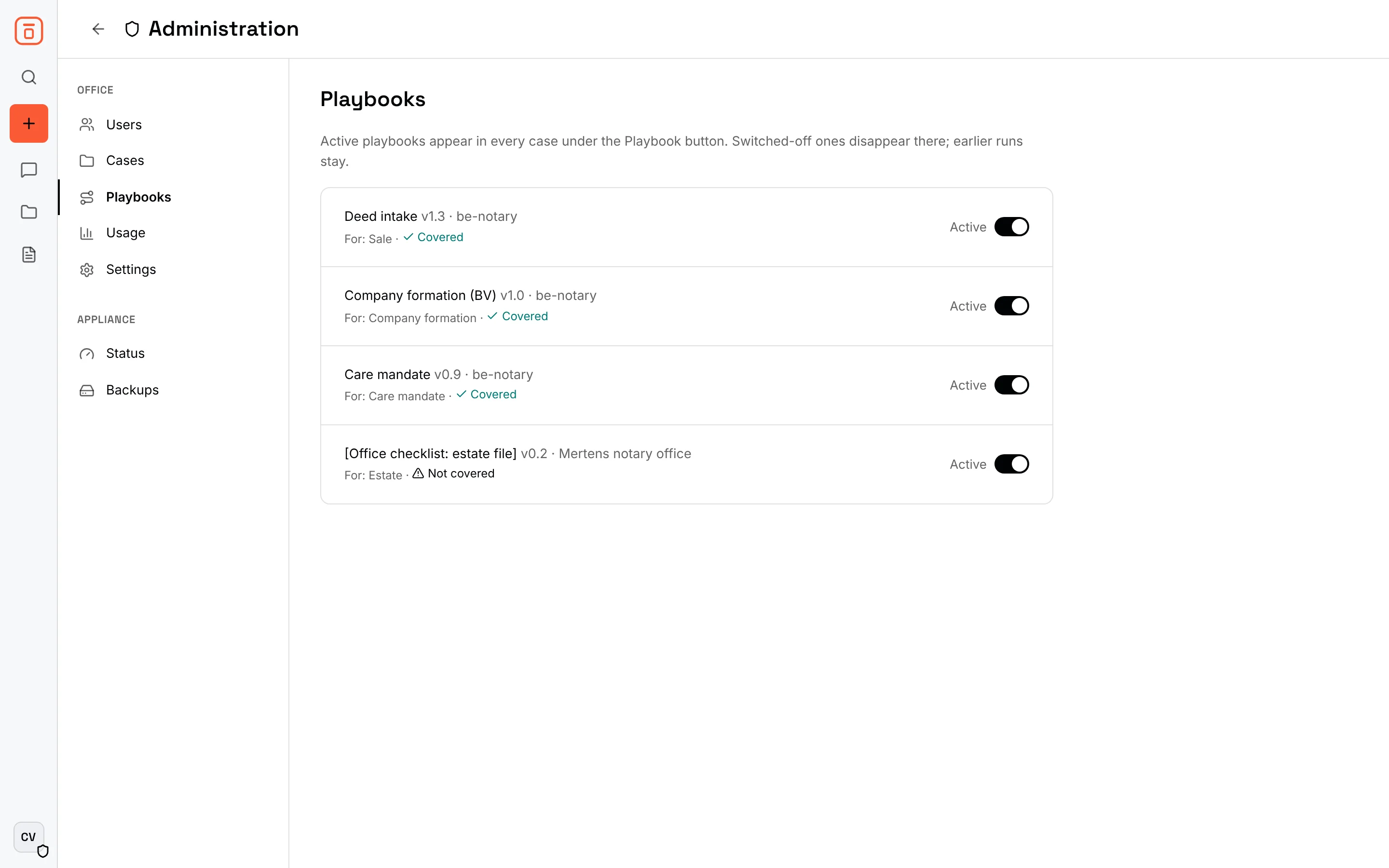
Administration › Playbooks: the installed playbooks with their version and whether a certified pack covers them; one of the office’s own is marked as not covered.
Example with fictional case files · click to enlarge

Three kinds of playbook

Frequently asked questions

Does a playbook replace the notary or the lawyer?

No. It does the collecting, reading and checking, and stops at every point where a judgement is needed. Nothing is confirmed by the model, and the product is a draft until a person approves it.

Can we write our own playbooks?

That is the intention: a playbook is a file an office can read and adapt. Today the official pack runs; uploading your own validated file is planned, and an editor comes later.

Why a file, and not a written instruction?

The file is what the software enforces: a step is done only when a person confirms it, whatever the model proposes. A written instruction would leave that to the model, and over a long run it drifts. Twenty lines can be read and certified; a paragraph the model follows cannot.

Does it work without an internet connection?

Yes. The runtime and the playbooks are on your appliance, and a step never calls outside it.

Which model does a playbook use?

Today every step runs on the appliance’s default model. A playbook will be able to name a role per step (reading, drafting, checking) that your administrator maps to the models installed on your appliance. Either way the run records the model behind every step.

What happens if we stop a run halfway?

Pause keeps everything and waits. Stop ends the run and keeps the confirmed facts and the products made so far, marked incomplete. Cancel withdraws its results and sets its facts back to proposed. In all three cases the run record stays.

Run a playbook on a file you know by heart

A pilot runs on closed files, on a server in your own office. You judge the routine yourself.

We reply within two working days.

Sūveryn for other practices